
Bacillus coagulans
Label nameLactoSpore® (Bacillus coagulans)
Also known asHeyndrickxia coagulans, Lactobacillus sporogenes (historic name), Spore-forming probiotic
Bacillus coagulans is a probiotic bacterium that forms protective spores. The spore coat helps it survive heat, storage and stomach acid, so it can reach the intestine and become active there.
Last reviewed November 19, 2026 by the Modern Genetix Editorial Team. Not medical advice.
The short answer
Bacillus coagulans, recently renamed Heyndrickxia coagulans, is a spore-forming probiotic with a strong safety record in toxicology studies [1],[2]. Clinical research on digestive comfort is promising but is still built on relatively few, small studies [3].
Quick facts
| Label name | LactoSpore® (Bacillus coagulans) |
|---|---|
| Also known as | Heyndrickxia coagulans, Lactobacillus sporogenes (historic name), Spore-forming probiotic |
| Category | Enzymes & probiotics |
| Role in formulas | Key active |
| Research tier | ClinicalHuman clinical trials or systematic reviews of trials, or an NIH fact sheet summarizing them. |
| Found in | GLP Enhance |
| Amount per serving | GLP Enhance: 166 mg (6 billion CFU) |
What the research says
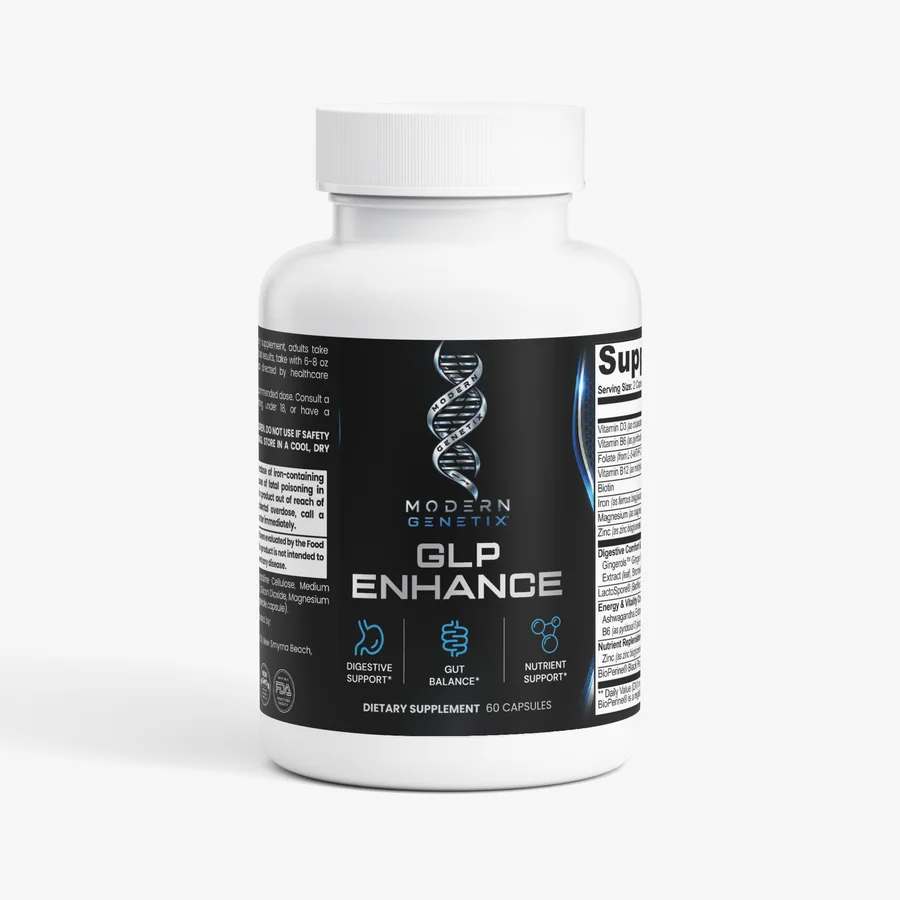
GLP Enhance includes LactoSpore® Bacillus coagulans at 166 mg, providing 6 billion CFU per serving. A spore-forming strain fits a capsule formula that also carries enzymes, minerals and botanicals, because spores stay stable on the shelf.
A 2019 review summarizes the biology of B. coagulans, its likely mechanisms in the gut, and toxicology studies and clinical observations showing it is safe, with no mutagenic, teratogenic or genotoxic effects [1].
Scientists now classify the species as Heyndrickxia coagulans. A 2024 review explains how its spores give it high resistance to harsh conditions and outlines the requirements for a strain to be called a probiotic [2].
An earlier review noted that, although spore-forming probiotics are increasingly used, clinical evidence comes from a limited number of small studies [3]. Research suggests B. coagulans is a stable, well tolerated probiotic for digestive support, with more large trials needed.
Evidence at a glance
Studies vs label doses
GLP Enhance provides 166 mg of Bacillus coagulans, listed as 6 billion CFU per 2-capsule serving.
| Product | As listed on the label | Per serving |
|---|---|---|
| GLP Enhance | LactoSpore® (Bacillus coagulans) | 166 mg (6 billion CFU) |
Where it appears
Bacillus coagulans is in 1 Modern Genetix formula.
Who it may suit, and who should ask first
May suit
- Adults wanting a shelf-stable probiotic inside a digestive formula
- People who travel or prefer products that do not need refrigeration
Ask a clinician first if you
- Have a weakened immune system or a serious illness
- Are pregnant, nursing or under 18
Safety
Toxicology studies and clinical use support a good safety profile [1]. As with any probiotic, people with weakened immune systems should ask a clinician first.
FAQ
Which Modern Genetix products contain Bacillus coagulans?
GLP Enhance: 166 mg (6 billion CFU).
How many CFU of Bacillus coagulans are in GLP Enhance?
6 billion CFU (166 mg) per 2-capsule serving.
Why does a spore-forming probiotic matter?
The spore coat protects the bacterium from heat and stomach acid, so it can survive until it reaches the intestine [2].
Is Bacillus coagulans the same as Lactobacillus sporogenes?
Yes. It was once sold under that name; it is now classified as Heyndrickxia coagulans [2].
How strong is the research on Bacillus coagulans?
We rate it Clinical. Human clinical trials or systematic reviews of trials, or an NIH fact sheet summarizing them.
Bottom line
Bacillus coagulans brings shelf stability and a strong safety record to GLP Enhance, adding a probiotic to its digestive comfort blend.
Related ingredients
References
- Mu et al. Bacillus coagulans and its applications in medicine. Benef Microbes. 2019. PubMed 31203635 · doi:10.3920/BM2019.0016
- Liang et al. Progress of research and application of Heyndrickxia coagulans (Bacillus coagulans) as probiotic bacteria. Front Cell Infect Microbiol. 2024. PubMed 38863834 · doi:10.3389/fcimb.2024.1415790
- Drago et al. Should Lactobacillus sporogenes and Bacillus coagulans have a future?. J Chemother. 2009. PubMed 19622453 · doi:10.1179/joc.2009.21.4.371
Sources were checked by the Modern Genetix Editorial Team on November 19, 2026. Links open PubMed, the publisher DOI or NIH.