
Valerian
Label nameValerian Extract (root)
Also known asValeriana officinalis, Garden heliotrope, All-heal
Valerian is a flowering plant native to Europe and Asia whose root has been used as a nighttime herb since ancient Greece and Rome. Its earthy smell comes from compounds called valerenic acids and valepotriates.
Last reviewed November 19, 2026 by the Modern Genetix Editorial Team. Not medical advice.
The short answer
Pooled clinical trials suggest valerian root may help improve subjective sleep quality, though results vary between studies and preparations [1],[2]. A 2024 umbrella review rated the evidence as limited, so valerian is best seen as one part of a calm evening routine [3].
Quick facts
| Label name | Valerian Extract (root) |
|---|---|
| Also known as | Valeriana officinalis, Garden heliotrope, All-heal |
| Category | Botanicals & adaptogens |
| Role in formulas | Key active |
| Research tier | ClinicalHuman clinical trials or systematic reviews of trials, or an NIH fact sheet summarizing them. |
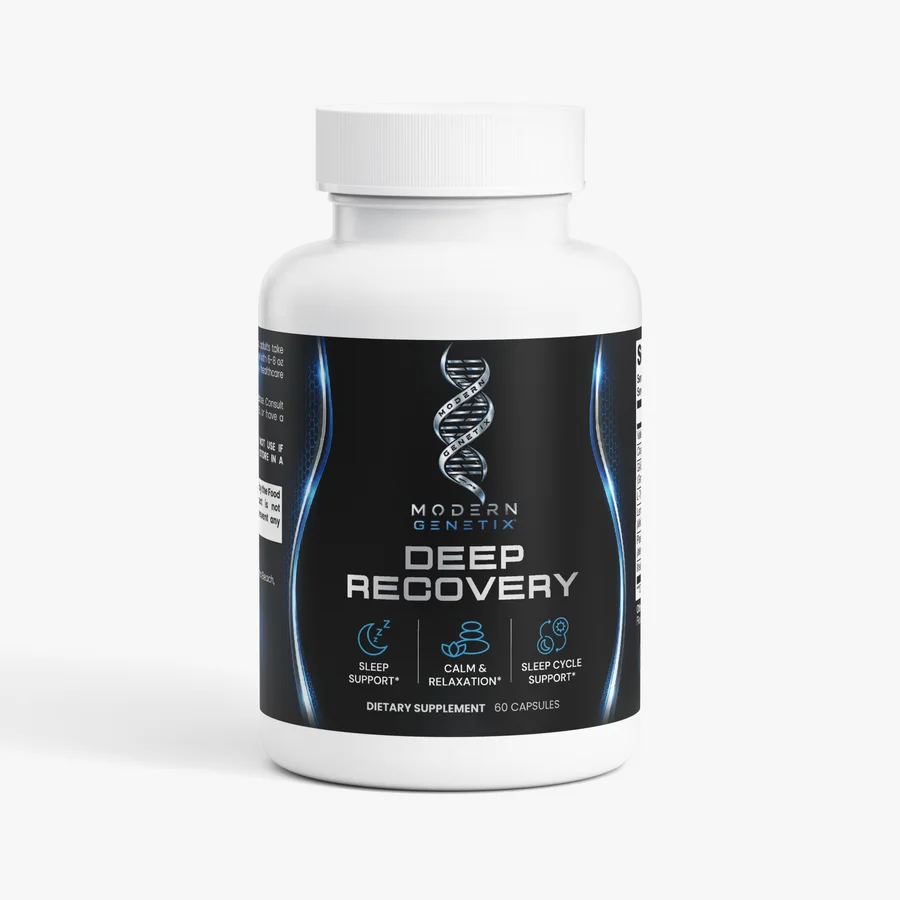
| Found in | Deep Recovery |
| Amount per serving | Deep Recovery: 150 mg |
What the research says
Valerian leads Deep Recovery at 150 mg of root extract per 2-capsule serving, alongside chamomile, GABA, L-tryptophan, lemon balm, passionflower and 2 mg of melatonin.
A 2020 systematic review covering 60 studies and nearly 6,900 participants concluded that valerian could be a safe herb to promote sleep, while noting that its active compounds are unstable and that preparations vary widely [1]. An earlier meta-analysis found valerian might improve subjective sleep quality without producing side effects, and called for studies using standardized preparations [2].
Not every review agrees. A 2024 umbrella review of the evidence found existing studies to be heterogeneous and of low methodological quality, and did not recommend valerian as a stand-alone approach for chronic sleep difficulty [3]. NCCIH similarly describes the evidence as inconsistent [4].
The fair reading is that research suggests a modest, subjective benefit for some people. That is one reason Deep Recovery combines valerian with other calming botanicals and a small dose of melatonin rather than relying on any single ingredient.
Evidence at a glance
Studies vs label doses
Clinical studies have used a wide range of valerian extract doses and preparations [1]. Deep Recovery provides 150 mg of valerian root extract per serving.
| Product | As listed on the label | Per serving |
|---|---|---|
| Deep Recovery | Valerian Extract (root) | 150 mg |
Where it appears
Valerian is in 1 Modern Genetix formula.
Who it may suit, and who should ask first
May suit
- Adults who want a botanical approach to winding down
- People building a consistent evening routine
Ask a clinician first if you
- Are pregnant, nursing or under 18
- Take sedatives, sleep medicines or drink alcohol in the evening
- Have liver problems or a scheduled surgery
Safety
Valerian is generally well tolerated in studies lasting a few weeks; reported side effects include headache, dizziness and morning grogginess [4]. Do not drive or operate machinery after taking it.
FAQ
Which Modern Genetix products contain Valerian?
Deep Recovery: 150 mg.
How much valerian is in Deep Recovery?
150 mg of valerian root extract per 2-capsule serving.
Why does valerian smell so strong?
Its compounds, including valerenic acids, give the root a strong, earthy odor. It is normal and does not mean the product has gone off.
Is valerian habit forming?
Studies have not shown dependence at typical doses, but it should still be used as directed [4].
How strong is the research on Valerian?
We rate it Clinical. Human clinical trials or systematic reviews of trials, or an NIH fact sheet summarizing them.
Bottom line
Valerian has centuries of tradition and a mixed but generally reassuring research record. In Deep Recovery it is one part of a layered nighttime formula.
Related ingredients
References
- Shinjyo et al. Valerian Root in Treating Sleep Problems and Associated Disorders-A Systematic Review and Meta-Analysis. J Evid Based Integr Med. 2020. PubMed 33086877 · doi:10.1177/2515690X20967323
- Bent et al. Valerian for sleep: a systematic review and meta-analysis. Am J Med. 2006. PubMed 17145239 · doi:10.1016/j.amjmed.2006.02.026
- Valente et al. Does valerian work for insomnia? An umbrella review of the evidence. Eur Neuropsychopharmacol. 2024. PubMed 38359657 · doi:10.1016/j.euroneuro.2024.01.008
- National Center for Complementary and Integrative Health (NIH). Valerian: Usefulness and Safety. www.nccih.nih.gov/health/valerian
Sources were checked by the Modern Genetix Editorial Team on November 19, 2026. Links open PubMed, the publisher DOI or NIH.